Friday, 11 April 2025

List of freight container relates ISO specifications

As mentioned, this blog is intended as a personal repository of EDI-related notes. 

I found out on Wikipedia the list of freight container relates ISO specifications. 

If you have further links, then share here with us!

  • ISO 668 - Freight containers - Classification, dimensions and ratings
  • ISO 830 - Freight containers - Terminology
  • ISO 1161 - Freight containers - Corner fittings - Specification
  • ISO 1496 - Freight containers - Specification and testing
  • ISO 2308 - Hooks for lifting freight containers of up to 30 tons capacity - Basic requirements
  • ISO 3874 - Freight containers - Handling and securing
  • ISO 8323 - Freight containers - Air/surface (intermodal) general purpose containers - Specification and tests
  • ISO 9669 - Freight containers - Interface connections for tank containers
  • ISO 9711 - Freight containers - Information related to containers on board vessels
  • ISO 9897 - Container equipment data exchange (CEDEX)
  • ISO 10368 - Freight thermal containers - Remote condition monitoring
  • ISO 10374 - Freight containers - Automatic identification.

Saturday, 11 November 2023

WESTIM and emergency repair for reefer containers

I have never been a big fan of ISO 9897 EDI messages, mainly because of the lack of documentation and standardization. 

Recently, I have gathered info to report emergency repair for reefer containers in WESTIM EDI message and here is the output from some carriers. 

CMA CGM

In WESTIM, it is possible to report if a container is full or empty through CUI segment.
If the full empty indicator in CUI03 is L (full container) then this will trigger an emegency repair.

Esample: CUI+++L'

COSCO SHIPPING

In WESTIM, it is possible to report the container material (eg. aluminium, steel, etc.) through ERI segment. 
If the material code in ERI01 is B
then this will trigger an emegency repair.

Esample: ERI+B+MAN:01+ACEP'

GRIMALDI LINES

In WESTIM, it is possible to report extra information about the container throught FTX segments. 
If you report a FTX segment, between the TMA and UNT segments, with FTX01=CDX and FTX02=EMERGENCY REPAIR, then this will trigger an emergency repair. 

Esample: TXT+CDX+EMERGENCY REPAIR'

That's the 'short list' but I have, at least, other 3 different processes to implement for other carriers...

I would be very curious to collect your feed-back about this topic: do you use DESTIM rather than WESTIM? In case you go for WESTIM, how do you report emergency repair for reefer containers? 

Friday, 13 May 2022

Funny facts and BAPLIE file

It's funny to discover that, some facilities, are still not able to work with the BAPLIE file and use some complex EXCEL spreadsheet to capture and reporting the vessel stowage. 

Here below, the screenshot of a stowage plan entirely in EXCEL which includes very complex vbs scripts to summarize the discharge totals based on the port letter code:


I came across with it when a colleague contacted me to understand if any way to convert this file in a standard BAPLIE and could not believe my eyes!

Did you ever see something like this!?

Friday, 23 July 2021

Charge IMPORT STORAGE in a container terminal based on UN/EDIFACT files

If you work in a container terminal and you are in charge for invoicing processes, that's a very handy flow chart about where to retrieve sensitive info to charge import storage.

Hope it can be useful to you!


Thursday, 8 July 2021

Questions sent via email

Often I receive emails with questions about EDI. 

I do not answer to emails whilst will be more than happy to support and share through the dedicated forum which is available here

Get your subscriptions and feel free to make all your questions so we can share and be useful for the whole "EDI Community". 

Thanks!

Friday, 21 May 2021

Options to report VGM data for incoming export containers

One of the funniest things connected to the SOLAS regulation, is that terminals can report the VGM of incoming export containers in several ways. 

    1. The recommended option: VERMAS

VERMAS incorporates information on the Verified Gross Mass (VGM) of a packed container, the time, place and method of determination of the VGM, the responsible parties, and references required by the receiver to assign the VGM to his transactions. If terminals want to go for standard option then that's definitely the right choice.


    2. The alternative option: including VGM data to the Full-In CODECO

In order to comply SOLAS requirements, CODECO SMDG 16 maintained by SMDG, includes amendments for transmission of data specifying a container’s verified gross mass (VGM) according to SOLAS regulation 2,chapter VI, paragraphs 4-6. If terminals cannot handle VERMAS, that's a good option.


    3. The last option: sending VGM with a separate Equipment Status Change CODECO

If, for any reason, terminal needs to keep separate the VGM process and the Gate process and cannot handle VERMAS then sending a CODECO with BGM0101=999 (Equipment Status Change Report) is definitely a good option.


Each option has both pros and cons but now, the real question is: which option do you use?

Friday, 29 May 2020

EDI processes in a modern container terminal [video]

I'm very glad to host on my blog the video of Luc Castera, the founder of Octopi, about the EDI processes in a modern container terminal: have a look at it, because it definitely worth the time!

EDI For Container Terminals: An Overview from Octopi by Navis on Vimeo.

Saturday, 2 May 2020

BAPLIE and flat rack bundle

Sometimes, the gap between MIGs and reality is definitely huge.

A good example comes from BAPLIE and flat rack bundle: here below, the correct way to report a bundle of flat in BAPLIE version 3. 


Sample comes from SMDG MIG which is available on the SMDG site or here.

Friday, 27 September 2019

Standardization problems

Standardization is definitely a complicated process: tons of MIGs are available on the web but end users always find the way to create unpredictable variables to prevent a correct data processing.  

Recently, I'm struggling with an issue about the VAT number of freight forwarders/custom brokers reported into COREOR D00B: apparently, it's unclear if the nation code has to be included, as NAD02, in NAD segment when reporting the VAT number

In terms of message structure, that's the issue: 

NAD+FW+IT03450730100:160:ZZZ'

OR

NAD+FW+03450730100:160:ZZZ'

Value reported in NAD02, is the target value to transcoding hence the prefix 'IT' makes a big difference when applying the mapping rules and the translation rules.

I'm quite interested in collecting feed-back about this topic: in case you are experiencing the same issue in your EDI environment, you can drop a comment here!

Sunday, 2 June 2019

TPFREP pool results

Time ago a run a pool about TPFREP potential receivers: finally, here below the results that I'm glad to share with you: 


Saturday, 18 May 2019

Tricks when debugging an EDI transaction

Sometimes you might need to debug some EDI transactions and the lack of CR/LF can be an issue. I found out that Notepad++ can easly fix this issue:

But that's just the tip of the iceberg! I have developed a bunch of macros that can be used in a wide range of scenarios and that's a small sample: due to some internal procedures, I needed to remove the goods description into BAPLIE file but did not have the chance to edit related mapping rule. Goods description is stored in Segment Group 5 as FTX04:

FTX+AAA+++FAK OR CARGO  NOS WITH REFERENCE 998740013'

Applying the following criteria, in conjunction with CR/LF, will purge unwanted information and will change segment as follow: 

FTX+AAA+++'

                                    
Hope these tricks will be useful to you!

Wednesday, 25 October 2017

My best free tool for BAPLIE

In this post, I will review my best BAPLIE free tools available on the internet.

1. BAPLIE Viewer


It's a great and reliable tool developed many many years ago.
I know for sure that several small Terminals have used the BAPLIE Viewer as standard and unique ship planning program which may confuse you unless you never gave it a try.
BAPLIE Viewer has tons of functionalities; here below some of them: 

Files exported by the prgram:
  • CSV comma separated
  • TXT text files TAB delimited
  • DBF, dBase IV file
  • Microsoft Excel using preset template or to new worksheet
  • Clipboard copy of data
Reports genrated:
  • Container list, filtered and sorted
  • IMDG list; list of dangerous cargo, filtered by port of discharge or displayed as transit cargo
  • Reefer list; list of reefer containers; filtered by port of discharge and status (all, dry, live and empty reefer containers)
  • Cargo summary; summary of all cargo on board by port of discharge
  • Container data; selected container data from BAPLIE file
  • Break bulk; summary of all break bulk cargo from BAPLIE file
  • Suez canal report (cargo summary)
  • Stack weight summary separate for deck and hold; 20FT, 40FT or mixed stowage
  • OOG (Out of Gauge) containers summary with particular dimensions
  • Container remarks; Handling instructions, Special instructions, Container remark, Description of goods, General information's
Statistics created: 
  • General statistics; selection of different statistics per container type, operator, owner, etc...
  • Tonnage sheet; break down of cargo by units and weight, operator, owner, container size, load and discharge port
  • IMDG cargo summary; summary of dangerous cargo by class; port of discharge, container size, deck or hold
  • Container type summary; different container types filtered by line operator
  • Transversal weight distribution; weights and horizontal moments, calculation of cargo induced ship list
  • Load port summary by operator; break down of cargo on board by operator, loading and discharge port
Additional tools and options:
  • Decode and display content of BAPLIE file header
  • Removal of line feeds and unprintable characters from BAPLIE file
  • Create query to extract data from file
  • BAPLIE file analysis; checking for different errors in BAPLIE file and/or stowage
  • Bay view; graphical display of cargo stowage with different coloring filters
  • Cargo plan; graphical display of cargo plan with different coloring filters
  • ISO container types decoder
  • ISO port codes; 8283 ports, automatically decoded for Baplie viewer, but can be used as separate routine
  • Container Id check digit calculation
Support
BAPLIE 1.5, 2.07, 2.1, 3.0

Pros:
Tons of statistical reports;
Handy data export tool in several formats (including the Plan Master format).
Bay plan and letter plan printing;

Cons:
Not updated since 2005;
Does not validate message;
Does not support VGM.


2. EDIFACT Viewer

It's a great tool which supports not only BAPLIE but also several UN/EDIFACT messages.
Here the full list of supported messages. 
The EDIFACT Viewer allows to export messages in csv and html files plus has a very intuitive GUI to menage the contents of your files.

Support
All BAPLIE versions; 

Pros:
Easy to use; 
Solid message translation/acknowledgment; 
Support to VGM; 
Also tested on several Linux distros with Wine.


Cons:
The last updated version was released in 2010;
Does not validate message.


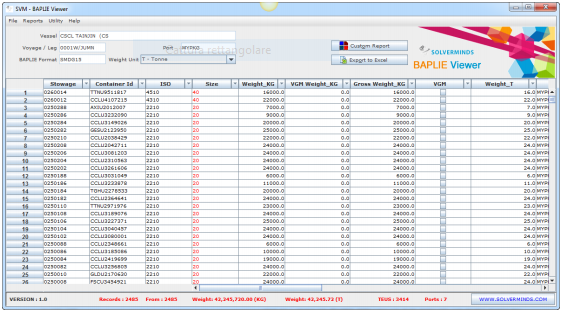
3. SVM BAPLIE Viewer

It's a very recent development which requires java in order to run on your pc.

SVM BAPLIE Viewer also validates the file and lets you know if there are any incorrect or missing segments which may prevent the file from being read and converted.
SVM BAPLIE Viewer allows to create customized data export templates which include the count function: template then can be saved on your pc and used as soon as you need it. 

Support:
SMDG15/BAPLIE 1.5, SMDG20/BAPLIE 2.0, SMDG22/BAPLIE 2.2 and SMDG31/BAPLIE 3.1.

Pros:
Customized template to export data;
Allow to handle data in pivot table style;
Support to VGM.


Cons: 
Requires an old and unsafe java version (Java JRE 1.6).


Wednesday, 8 March 2017

EDI translator enquiry

I would be glad to gather info and suggestions about EDI translator tools with the below functionalities: 

  1. Graphical mapping from CSV to EDIFACT and vice versa; 
  2. Code conversion maintenance through local tables; 
  3. Batch send/receipt with support to SMTP/FTP/SFTP services. 
Please, do not sponsor any external EDI service: I'm not interested in that and all subsequent posts will be deleted.

You can share your proposals here or also sending an email to: myedinotes@gmail.com.

Friday, 25 November 2016

SOLAS and COPRAR

One the funniest consequences of the SOLAS is that some customers started to report decimal values into segment MEA as MEA03:
EQD+CN+ABCD1234567+22G1:102:5++2+5'
RFF+BN:123456789'
LOC+11+ITGOA:139:6'
LOC+7+PFPPT:139:6'
MEA+AAE+VGM+KGM:20010.000'
SEL+002337'
SEL+057155'
FTX+AAA+++VIRGIN OLIVE OIL AND ITS FRACT'

Assuming that some hectograms may be relevant while stowing a container onto vessel, it's important to remember that, in all the MIG, MEA03 has the below characteristics:


The code n..18 means that this piece of data is a numerical data type with a a maximum length of 18 numbers and 0 number of decimals.

In a nutshell: reporting decimal numbers into MEA03, it should not be considered a good practice.

Edit - 28/11/2016
I have done some extra checks about this topic and it seems that decimal dots are allowed in case of data element with the following characteristics: n..18.

The below information comes from UNECE web page:

10.1 Decimal Mark
The ISO representation for decimal mark is the comma ( , ) but point on the line ( . ) is allowed. See ISO 31/0-1981. Both these characters are part of the Level A and B sets in
clause 5 and both alternatives are allowed. When the Service string advice, UNA, is used, its third character specifies the one character used in the interchange to represent decimal mark and thus overrides the above alternative use. The decimal mark shall not be counted as a character of the value when computing the maximum field length of a data element. However, allowance has to be made for the character in transmission and reception. When a decimal mark is transmitted, there shall be at least one digit before and after the decimal mark. For values represented by integers only, neither decimal mark nor decimal zeroes are used unless there is a need to indicate the degree of precision. 
Preferred  0,5 and 2 and 2,0
Allowed    0.5 and 2 and 2.0
Not allowed:  ,5 or .5 or 2, or 2.

10.2 Triad Separator
Triad separators shall not be used in interchange. 
Allowed: 2500000
Not allowed: 2,500,000 or 2.500.000 or 2 500 000

Monday, 9 May 2016

The impact of SOLAS on BAPLIE

VGM can be sent from Terminal operator via BAPLIE file.

That's a sample built on BAPLIE version 3.1 which is the very last stable version. This message version may be used to transmit data about VGM of containers. Usage of the according data elements is optional and needs to be agreed between communication partners. This message version provides for transmission of:
  • Indication whether a specified gross mass has been verified or not
  • Additional information providing evidence of verification.

(...)
LOC+147+0010082:9711:5'
EQD+CN+SUDU1234569:6346:5+42G1:6346:5+++5'
NAD+CF+OOL:LINES:306'
MEA+AAE+VGM+KGM:23780'
RFF+BN:SGSIN00002'
FTX+AAY++SM1:VGM:306+201606211600UTC:CWC LTD; PO BOX 987; CITY;?+1526888999:JOHN SMITH;WEIGHT MASTER EAST GATE:JOHN SMITH:US'
(...)

Note here below related codes: 

c107.4441 
SM1= SOLAS verification method used

c107.1131 
Verified Gross Weight

c108.4440 
201606211600UTC= Data/Time weight verification

c108.4440 
CWC LTD; PO BOX 987; CITY;?+1526888999= Data/Time when issued weighing party

c108.4440 
JOHN SMITH;WEIGHT MASTER EAST GATE= Contact Address Responsible Person

c108.4440
JOHN SMITH= EDI Signature

c108.4440
US= State where verified

It's also possible to state the verification document reference with the code DRF as c107.1131:

(...)
LOC+147+0010082:9711:5'
EQD+CN+SUDU1234569:6346:5+42G1:6346:5+++5'
NAD+CF+OOL:LINES:306'
MEA+AAE+VGM+KGM:23780'
RFF+BN:SGSIN00002'
FTX+AAY++DRF:VGM:306+201606211600UTC:JOHN SMITH:WEIGHT MASTER EAST GATE:DOCUMENT-ID'
(...)

Samples come from SMDG MIG: I have uploaded it here for your findings.

The impact of SOLAS on COPARN

VGM can be sent from Line to the Terminal operator, via COPARN, before container arrives full via truck.

Here below a sample:

UNH+00000000006944+COPARN:D:95B:UN:SMDG16'
BGM+11+800255846++AB'
RFF+BN:800255846'
TDT+20+048R+1++TEST:172:20+++CALL_SIGN:103::TEST_VESSEL:PA'
RFF+VON+048'
LOC+9+AUMEL:139:6:MELBOURNE+CONWS: TER:ZZZ:P&O PORTS'
DTM+132:200212290600:203'
NAD+MS+LINE:172:20'
CTA+IC+:STAN MATTHEWS'
EQD+CN++4532:102:5+2+2+5'
RFF+SQ:1'
EQN+1'
TMD+3++1'
DTM+798:200211211700:203'
LOC+11+ZACPT:139:6'
LOC+8+ZAJNB:139:6'
MEA+AAE+VGM+KGM:10474'
TMP+2+011:CEL'
FTX+AAA+++CHOCOLATES'
FTX+ABS++SM1:ZZZ:SMD’
TDT+1++3'
DTM+132:200212270600:203'
LOC+165+AUMEL:139:6'
NAD+AM+++JOHN DILLINGER’
CNT+16:1'
UNT+26+00000000006944'

Note the below codes:

    1) EQD.DTM; DTM01=798 (Data/Time weight verification)
    2) EQD.MEA: MEA02=VGM (Verified Gross Weight);
    3) EQD.FTX: SM1 (SOLAS verification method used);
    4) In NAD: NAD01=AM (EDI SIGNATURE).

The above sample (vers. D95B) comes from SMDG MIG: I have uploaded it here for your guide.


Thursday, 7 April 2016

How to Choose a Terminal Operating System (TOS)

This post is a little bit off topic.

If you work in a container terminal, you should be familiar with the word TOS. 

According Wikipedia:

"A Terminal Operating System, or TOS, is a key part of the supply chain and primarily aims to control the movement and storage of various types of Cargo in and around a Container terminal or Port. The systems also enables you to make better use of your assets, labour and equipment, plan your workload, and get up to the minute information which allows for more timely and cost-effective decision making.

Terminal Operating Systems often utilize other technologies such as internet, EDI processing, mobile computers, wireless LANs and Radio-frequency identification (RFID) to efficiently monitor the flow of products in, out and around the terminal. Data is either a batch synchronization with, or a real-time wireless transmission to a central database. The database can then provide useful reports about the status of goods, locations and machines in the terminal.
The objective of a terminal operating system is to provide a set of computerized procedures to manage cargo, machines and people within the facility to enable a seamless link to efficiently and effectively manage the facility.
Terminal operating systems can be stand alone systems, managed as a service or utilize cloud technologies.
In its simplest form, the TOS can data track cargo in and out of a terminal."
I came across a very interesting post on Linkedin about what to take into the account If you are in the process of choosing a new TOS.

Here the full story!

Wednesday, 30 March 2016

The impact of SOLAS on CODECO

I think that everybody is aware about SOLAS and the new container weight verification requirements that are going to be mandatory from the 1st of July (here for further information). 

The goal of this post is to show the impact of the SOLAS on CODECO D.00B.

All the below samples come from SMDG MIG that you can download here

Scenario #1: CODECO reporting Gate In message with (unverified) booking weight:

BGM+109+800255846+9+AB
(...)
EQD+CN+PONU4863849+4532:102:5+2+2+5'
RFF+SQ:1'
EQN+1'
TMD+3++1'
DTM+7:201512271639:203'
LOC+11+ZACPT:139:6'
LOC+8+ZAJNB:139:6'
MEA+AAE+AET+KGM:10474'
(...)

Scenario #2: Container arrived at the gate with Transport equipment verified gross mass (weight) already announced to the terminal via e.g. COPARN (update) message:

BGM+109+800255846+9+AB'
(...)
EQD+CN+PONU4863849+4532:102:5+2+2+5'
RFF+SQ:1'
EQN+1'
TMD+3++1'
DTM+7:201512271639:203'
LOC+11+ZACPT:139:6'
LOC+8+ZAJNB:139:6'
MEA+AAE+VGM+KGM:12373'
(...)

Scenario #3: Container was weighed at Gate In to ascertain Transport equipment verified gross mass (weight):

BGM+109+800255846+9+AB'
(...)
NAD+CF+PON:172:20'
CTA+IC+:GATE OPERATIONS'
COM+019858934:TE'
NAD+WPA+CONWS:72:SMD’
CTA+BN+: JOHN SMITH'
COM+019858934:TE'
EQD+CN+PONU4863849+4532:102:5+2+2+5'
RFF+SQ:1'
RFF+VGR:V123456667’
EQN+1'
TMD+3++1'
DTM+7:201505271639:203'
DTM+WAT:201505271651:203'
LOC+11+ZACPT:139:6'
LOC+8+ZAJNB:139:6'
MEA+AAE+VGM+KGM:12373'
(...)

Scenario #4: Container arrived at the gate without a Transport equipment verified gross weight and was stacked in the yard as such. Container was weighed at the terminal to obtain the Transport equipment verified gross weight:

BGM+266+800255846+9+AB'
(...)
DTM+137:201511211523:203'
RFF+BN:800255846'
RFF+VOR:V00012345’
NAD+CF+PON:172:20'
NAD+WPA+CONWS:72:SMD’
CTA+BN+ :JOHN SMITH'
COM+019858934:TE'
EQD+CN+PONU4863849+4532:102:5+2+2+5'
DTM+WAT:201505271651:203'
LOC+175+AUMEL:139:6:MELBOURNE+CONWS:72:SMD’
MEA+AAE+VGM+KGM:12373'
(...)

Finally, here are the codes assigned by UN/CEFACT as proposed/prototyped by SMDG

RFF 1153 - Reference code qualifier
  • VGR: Reference number identifying the documentation of a transport equipment gross mass (weight) verification;
  • VOR: Reference number identifying the order for obtaining a Verified Gross Mass (weight) of a packed transport equipment as per SOLAS Chapter VI, Regulation 2, paragraphs 4-6.
MEA 6313 - Measured attribute code
  • VGM: The gross mass (weight) of the transport equipment verified according to SOLAS Chapter VI, Regulation 2, paragraphs 4-6.  
NAD 3035 - Party function code qualifier
  • WPA: Weighing party.
DTM 2005 - Date or time or period function code qualifier
  • WAT: Date/Time when a gross mass (weight) of a packed container was obtained according to SOLAS chapter VI, regulation 2, paragraphs 4-6.

Wednesday, 22 April 2015

Code Searh (Update to version 1.1)

I have uploaded a new version of Code Seach with an updated SMDG code list.

You can download it here.

Thursday, 19 February 2015

TPFREP [Pool]